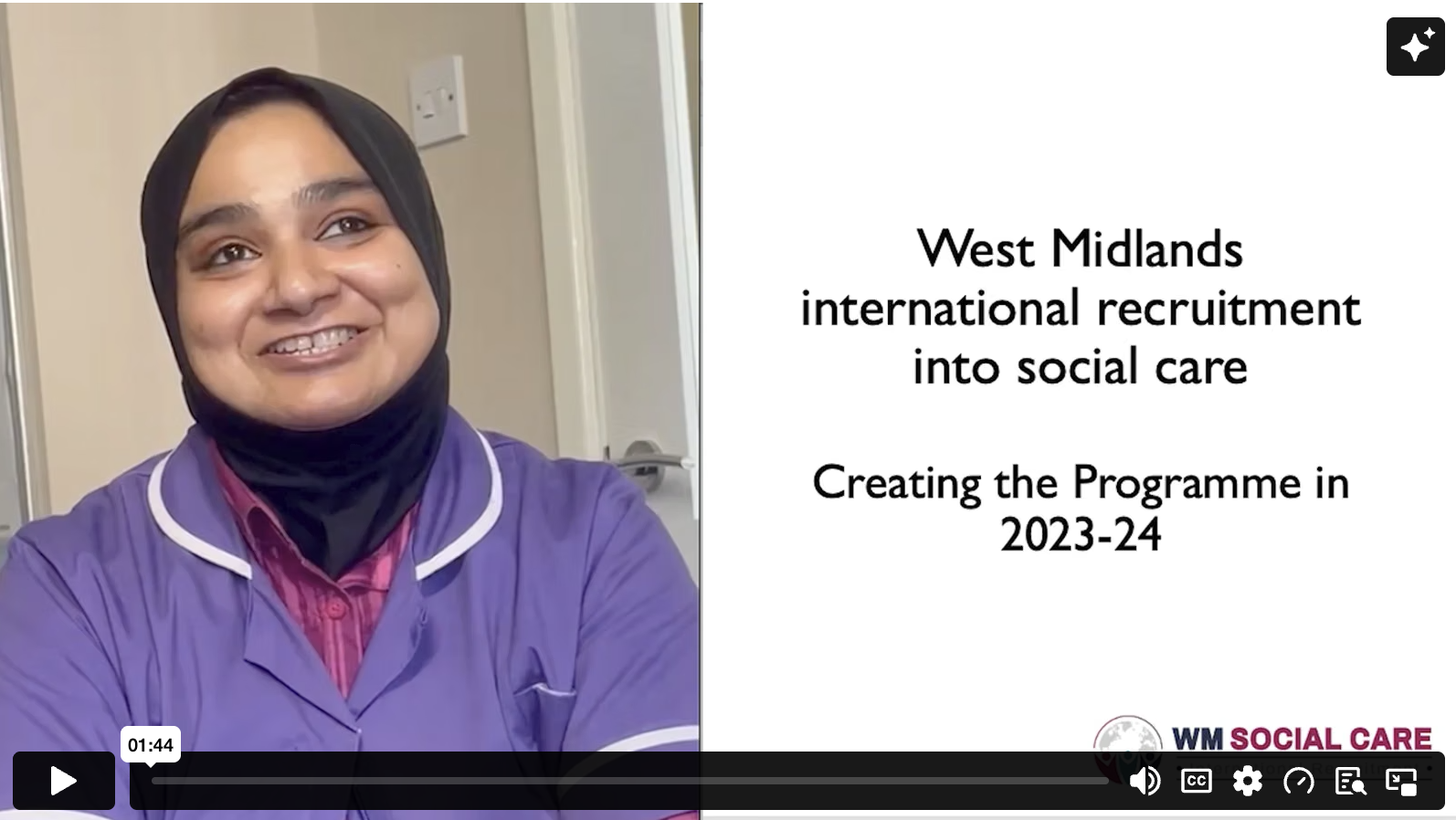
Gill Kelly, Former Programme Director of the West Midlands International Recruitment Programme, talks about how the West Midlands International Recruitment Programme began.
She shares why it was created – to recruit international care workers safely and ethically – and discussed some of the work carried out and support provided.
As Gill Kelly prepared to leave her role, as Director of the West Midlands International Recruitment Programme, we took the opportunity to reflect with her on the Programme’s journey, the challenges faced along the way, and the lessons that could help shape the future of adult social care.
Over the last three years, the programme has navigated significant change. What began as a response to workforce shortages and a need for ethical international recruitment evolved into something much broader: responding to changing national policy, strengthening partnership working across the region, tackling exploitation, and supporting displaced international care workers while ensuring they remained at the very heart of decision-making.
Throughout our conversation, one message came through clearly: whilst the context changed, the programme never lost sight of the people at its heart.
Building the Foundations
As Gill reflected, the International Recruitment Programme arrived at a critical time for the sector.
Following Brexit and the impact of the Covid-19 pandemic, workforce shortages were being felt across adult social care. International recruitment offered one way to help address those pressures, but there was also a need to ensure recruitment was undertaken safely, ethically and with appropriate support for both employers and workers.
When Gill started West Midlands ADASS had already achieved an agreed proposal and funding for the International Recruitment Programme.
The Programme focus was to support ethical international recruitment across adult social care at both regional and local level. Gill pointed out that providers were at different stages of their international recruitment journey and local authorities did not have a clear picture of what was happening locally. In common with all other regions, there was no intelligence on international recruitment activity.
Gill says, “We needed to find a data solution to see which care providers had sponsorship licences. With this we were able to start targeting support for sponsoring employers. This information proved to be so crucial to the Programme that the Department of Health and Social Care (DHSC) subsequently funded its expansion across the country so other regions really benefitted from this too.”
Adapting to an Evolving Landscape
Alongside continued international recruitment, increasing numbers of care providers across the country began experiencing sponsorship licence revocations due to failure to comply with United Kingdom Visa & Immigration (UKVI) requirements.
As a result, growing numbers of international care workers found themselves displaced from employment, thus cut off from income. The West Midlands region saw growing numbers of displaced international care workers as well as well as increasing evidence of exploitation.
The DHSC responded by broadening the aims of the International Recruitment Programmes to include supporting displaced international care workers into alternative ethical employment and also tackling exploitation.
New support mechanisms were established, including dedicated mailboxes, job-matching support, an AI support platform, provider training, legal helpline, local support projects and wraparound pastoral care.
Local authorities developed innovative approaches to find and work with the displaced care workers. Community based organisations were brought in to outreach to and support displaced workers.
New approaches to tackling exploitation locally and regionally were also developed. Sandwell Metropolitan Borough Council and Staffordshire Local Authorities developed regional and local approaches respectively.
Exploitation awareness was and continues to be promoted across the West Midlands Region, with WM-ADASS working in partnership with Sandwell to deliver Exploitation Case Assistance Sessions – these are designed to support professionals managing complex exploitation concerns across the West Midlands. They are interactive online sessions bringing together professional guidance, collaborative problem-solving, and shared learning in a safe and supportive environment.
Gill says, “I am so proud of this work. I truly believe the West Midlands’ anti-exploitation work is a distinctive exemplar that will really benefit the broader sector in the West Midlands.”
Alongside these challenges the legal and policy landscape for the international care workers drastically changed. In March 2024 arriving care workers were no longer able to bring dependents. In July 2025 the government closed the health and care worker visa route meaning international recruitment for care workers stopped.
These changes represented a fundamental change from the large scale international recruitment of care workers seen between 2021 and 2024. Today, international care workers still face massive uncertainty due to the government’s current proposal to lengthen the time period for earned settlement / indefinite leave to remain.
Despite significant policy changes and continuing uncertainty, the programme has remained focused on supporting employers and international care workers across the region. In many ways, these challenges tested the strength of the foundations built over the previous three years.
Click here to read Part Two, where Gill reflects on the power of collaboration, the lessons learned from supporting international care workers, and what the future could hold for workforce development across adult social care.